

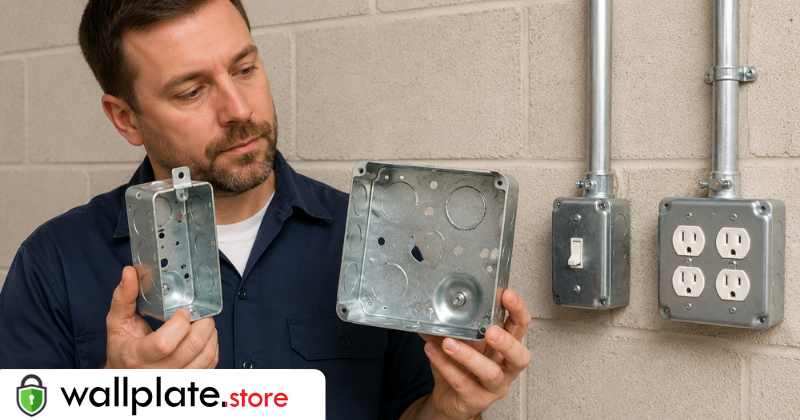
If you are installing an electrical switch, receptacle, or junction box for an exposed wiring project, you will often need to choose between a handy box and a 4-inch square electrical box.
Both are commonly used in surface-mounted electrical installations with EMT conduit or rigid conduit, but they are not the same. They use different covers, serve different purposes, and are designed for different types of installations.
What Is a Handy Box?

A handy box, also called a utility box, is a compact metal electrical box that is approximately 2 inches by 4 inches. It is mostly used for single-device installations.
Handy boxes are commonly used with:
- Light switches
- Duplex receptacles
- GFCI outlets
- Emergency shutoff switches
- Blank utility covers

Because of their smaller size, handy boxes use utility-size covers. These are not the same as standard wall plates and they are not the same as 4-inch square raised covers.
Handy boxes are popular for exposed work in garages, basements, boiler rooms, workshops, utility rooms, and other areas where wiring is run on the surface of the wall.
What Is a 4-Inch Square Box?
 A 4-inch square electrical box is larger and more versatile than a handy box. It is commonly used in commercial, industrial, and exposed work applications.
A 4-inch square box can be used as a junction box with a blank cover, or it can be used with raised covers for switches, outlets, GFCI devices, and combination device layouts.
Common uses include:
- Junction boxes
- Single light switches
- Single receptacles
- Two switches
- Two outlets
- Switch and outlet combinations
- Blank covers
Welded vs. Drawn 4-Inch Square Boxes
4-inch square boxes are commonly available in two main styles: welded boxes and drawn boxes.
Welded 4-Inch Square Boxes

Welded square boxes are made from steel pieces that are joined together. They are very common in commercial and industrial settings.
They are often available in deeper sizes, which can be helpful when more wiring space is needed. The finish is usually more utilitarian and may not look as smooth as a drawn box.
Drawn 4-Inch Square Boxes

Drawn square boxes are made from a single piece of steel that is formed into shape. They usually have smoother rounded corners and a cleaner appearance.
Drawn boxes are also used in commercial spaces, but they are often preferred where the box will be visible and a neater finish is desired.
The Biggest Advantage of a 4-Inch Square Box
The biggest advantage of a 4-inch square box is flexibility. The same box can be used for many different installations simply by changing the cover.
For example, a 4-inch square box can be used with:
- Blank covers
- Single toggle switch covers
- Duplex receptacle covers
- Decorator/GFCI covers
- Two-gang switch covers
- Two-gang receptacle covers
- Combination switch and outlet covers
This makes 4-inch square boxes very useful for electricians, contractors, maintenance teams, and commercial installations.
Common Applications for Handy Boxes
Handy boxes are most commonly used where only one device is needed. They are compact, easy to mount, and work well with utility-size covers.
Common applications include:
- Single switches
- Single outlets
- Garage receptacles
- Basement outlets
- Workshop switches
- Utility room wiring
- Mechanical room installations
Handy boxes are also very commonly used for emergency on/off switch covers, such as gas burner or oil burner shutoff switches. These are often installed in boiler rooms on brick, block, or concrete walls.
Common Applications for 4-Inch Square Boxes
4-inch square boxes are commonly used in larger commercial and exposed work installations because they provide more wiring space and more cover options.
They are often used in:
- Commercial buildings
- Warehouses
- Schools
- Hospitals
- Retail stores
- Industrial spaces
- Parking garages
- Mechanical rooms
Mounting and Conduit Connections
Both handy boxes and 4-inch square boxes are commonly used for exposed work. They can be mounted directly to a wall, mounted with brackets, or attached using special stud brackets.
They are often connected with:
- EMT conduit
- Rigid conduit
- IMC conduit
These boxes are frequently installed on concrete, brick, block, metal framing, or other exposed surfaces.
Handy Box vs. 4-Inch Square Box Comparison
| Feature | Handy Box | 4-Inch Square Box |
|---|---|---|
| Approximate Size | 2" x 4" | 4" x 4" |
| Common Cover Type | Utility-size covers | 4-inch square raised covers |
| Typical Device Capacity | One device | One or two devices, depending on cover |
| Best Use | Single switch or outlet | Junction box, single-gang, or two-gang setup |
| Wiring Space | Smaller | Larger |
| Commercial Use | Good | Excellent |
| Exposed Work | Yes | Yes |
| Common Conduit | EMT or rigid conduit | EMT or rigid conduit |
Which Box Should You Choose?
Choose a handy box when you need a compact surface-mounted box for one switch, one outlet, or one utility-size cover.
Choose a 4-inch square box when you need more wiring space, more flexibility, or the ability to use the box for different cover configurations.
For commercial and industrial work, many electricians prefer 4-inch square boxes because one box can be used for many different setups by simply changing the raised cover.
Frequently Asked Questions
Can a handy box be used as a junction box?
Yes. A handy box can be used as a junction box with the correct blank utility cover, as long as the installation follows electrical box fill requirements and applicable electrical code.
Can a 4-inch square box hold two receptacles?
Yes. A 4-inch square box can hold two receptacles when used with the correct 2-gang raised cover.
What cover fits a handy box?
A handy box uses a utility-size cover. These covers are narrower than standard wall plates and different from 4-inch square raised covers.
What cover fits a 4-inch square box?
A 4-inch square box uses 4-inch square raised covers. These are available in many configurations, including blank, toggle, duplex, decorator, GFCI, two-gang, and combination covers.
Are handy boxes and 4-inch square boxes used for exposed work?
Yes. Both are commonly used for exposed electrical work, especially when wiring is run with EMT conduit or rigid conduit on brick, concrete, block, or unfinished walls.
Final Thoughts
Handy boxes and 4-inch square boxes are both useful for exposed electrical installations, but they are designed for different purposes.
A handy box is best for compact, single-device applications such as one switch, one outlet, or an emergency shutoff switch. A 4-inch square box is larger, more flexible, and better suited for commercial installations, junction boxes, and single- or two-gang device setups.
Choosing the correct box and matching cover will make your installation cleaner, safer, and easier to complete.